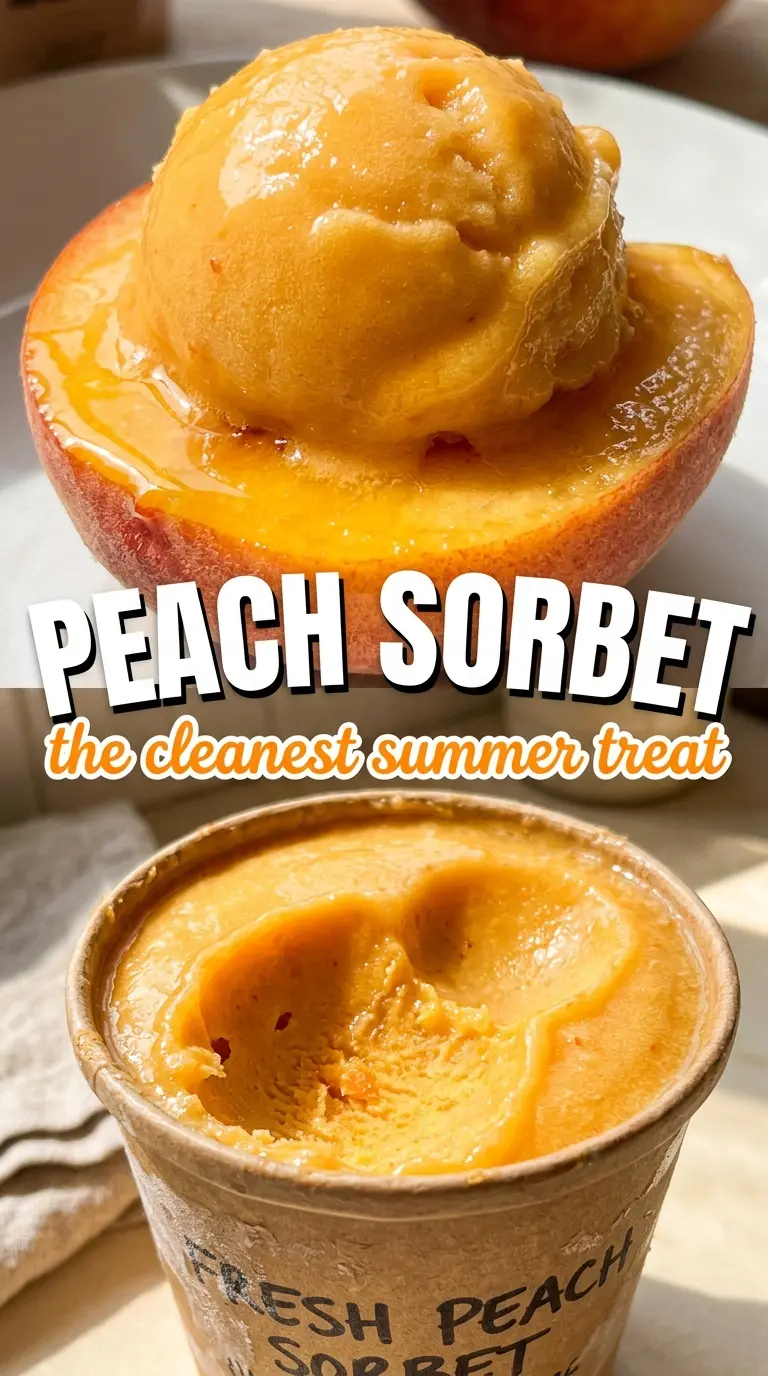
Luminous peach sorbet tastes like the best part of peak fruit season: cold, bright, and intensely peachy without any dairy to mute it. The texture lands somewhere between fluffy and crystal-clean, with just enough sweetness to taste like dessert and enough acidity to keep every bite lively. It’s the kind of frozen treat that disappears fast because it feels light on the tongue but still finishes with real fruit flavor.
The trick is in the balance. Ripe peaches bring the perfume and body, but they need a simple syrup base so the sorbet freezes scoopable instead of icy and hard. Lemon juice sharpens the fruit, vanilla adds a soft roundness in the background, and a pinch of salt keeps the flavor from tasting flat. If the peaches are fully ripe, you barely need anything else.
Below, I’ll show you how to get that smooth, scoopable texture, when straining is worth the extra minute, and what to do if your peaches are a little less sweet than you hoped. There’s also a smart way to make it ahead so it’s ready when you want it, not just when the churner finally finishes.
I strained mine and the sorbet turned out so smooth and scoopable. The lemon kept it from tasting flat, and after a couple hours in the freezer it had that perfect soft, icy texture.
Save this peach sorbet for the days when you want a pure fruit dessert with a bright, silky finish.
The reason peach sorbet turns icy instead of silky
Most homemade sorbets fail for one of two reasons: too much water or not enough sugar. Peaches already carry a lot of moisture, so if you blend them straight and freeze the puree, you end up with a block of flavored ice instead of a scoopable dessert. The simple syrup matters here because it does more than sweeten; it changes the way the mixture freezes.
Ripe fruit is non-negotiable. If your peaches taste bland at room temperature, they’ll taste bland after freezing, only colder. That’s why the lemon juice and salt matter too. They don’t make this sour or salty. They sharpen the peach flavor so it stays vivid after the cold dulls everything a little.
- Ripe peaches — Use peaches that smell fragrant and give slightly when pressed. Hard peaches will need more sugar to taste good, and they still won’t blend into the same naturally lush base.
- Simple syrup — This is what keeps the sorbet from freezing into a brick. Dissolve the sugar fully, then cool the syrup before blending so the mixture chills faster and stays brighter.
- Straining — If you want the smoothest texture, strain the puree after blending. Skip it if you like a little body and tiny fruit flecks in the finished sorbet.
What each ingredient is doing in the freezer
- Peaches — These carry the flavor, color, and body of the sorbet. Fresh ripe peaches give the cleanest taste, but frozen peaches can work in a pinch if you thaw and drain them first so the mixture doesn’t get watered down.
- Sugar — Sugar isn’t just for sweetness. It lowers the freezing point, which is what keeps the sorbet soft enough to scoop.
- Water — This makes the syrup, but it should be fully dissolved into the sugar before it touches the fruit. Undissolved sugar grains can leave the finished sorbet gritty.
- Lemon juice — This keeps the peach flavor from falling flat in the freezer. If your peaches are especially sweet, the lemon gives the sorbet the lift it needs.
- Vanilla extract — This is subtle, not bakery-like. It rounds out the fruit and adds warmth without pulling attention away from the peaches.
- Salt — A tiny pinch makes the peach flavor taste fuller. Leave it out and the sorbet can seem one-note.
The churn, freeze, and scoop window that matters
Building the syrup first
Start by heating the sugar and water just until the sugar dissolves completely. You don’t need a boil, just enough heat to make a clear syrup. If you rush this and leave grains behind, they can stay gritty in the finished sorbet. Cool the syrup all the way before blending it with the peaches so the fruit flavor stays fresh and the mixture chills faster.
Blending the fruit base
Blend the peaches with the cooled syrup, lemon juice, vanilla, and salt until completely smooth. Stop and scrape the blender if needed so there aren’t hidden chunks at the bottom. If the peaches were a little fibrous, this is the point where straining earns its keep. A fine mesh sieve gives you a cleaner, more elegant scoop.
Chilling before churning
Refrigerate the puree until it’s very cold before it goes into the ice cream maker. Cold base equals faster churn, and faster churn equals smaller ice crystals. If you skip this, the machine has to work harder and the texture tends to come out looser and less refined. Give it time in the fridge until it feels thoroughly cold all the way through.
Freezing to the right scoop point
After churning, the sorbet will still be soft, almost like a thick slush. That’s normal. Spoon it into a container and freeze until firm enough to scoop, usually at least 2 hours. If you leave it overnight, let it sit at room temperature for a few minutes before serving so the edges loosen instead of cracking under the scoop.
How to adapt peach sorbet when your peaches, tools, or diet change
Make it with frozen peaches
Thaw the peaches first and drain off any excess liquid before blending. Frozen fruit works, but it usually has more surface water, so skipping the drain step can make the sorbet icier and less concentrated.
No ice cream maker
Freeze the puree in a shallow pan and stir it every 30 minutes with a fork, breaking up the frozen edges as it sets. The texture won’t be quite as airy as churned sorbet, but it will still taste bright and clean if you keep the mixture very cold between stirs.
Lower-sugar version
You can reduce the sugar a little, but don’t cut it too far or the sorbet will freeze harder and lose scoopability. If the peaches are exceptionally sweet, shave off a few tablespoons of sugar and taste the puree before churning so you don’t overcorrect.
Dairy-free by nature
This recipe is naturally dairy-free, which is part of why the peach flavor stays so clean and bright. Don’t add milk or cream unless you want to turn it into a different dessert entirely; the fruit-forward texture is what makes sorbet work.
Storage and Reheating
- Refrigerator: Sorbet doesn’t store in the fridge well; it melts into peach soup. Keep it in the freezer in a tightly sealed container.
- Freezer: It keeps for about 2 weeks with the best texture. Press parchment or plastic wrap directly against the surface to slow ice crystals.
- Reheating: There’s no reheating here. Let frozen sorbet stand at room temperature for 5 to 10 minutes before scooping so it softens evenly instead of shaving off in hard shards.
Answers to the questions worth asking

Peach Sorbet
Ingredients
Equipment
Method
- Combine the granulated sugar and water in a saucepan and heat over medium until the sugar dissolves, about 3-5 minutes with occasional stirring.
- Remove the saucepan from heat and cool completely, until the syrup is room temperature.
- Add the diced fresh ripe peaches to a blender and pour in the cooled simple syrup, then blend until smooth, about 45-60 seconds.
- Blend in the lemon juice, vanilla extract, and salt until fully incorporated and the mixture looks uniform and silky.
- Strain the blended peach mixture through a fine mesh sieve for a very smooth sorbet, using a spoon to press it through.
- If you prefer texture, skip the straining step and keep the mixture as-is.
- Transfer the peach mixture to a container and refrigerate until very cold, at least 2 hours.
- Pour the cold mixture into an ice cream maker and churn until thickened and icy, 20-25 minutes.
- Transfer to a freezer-safe container and freeze at least 2 hours until firm enough to scoop.